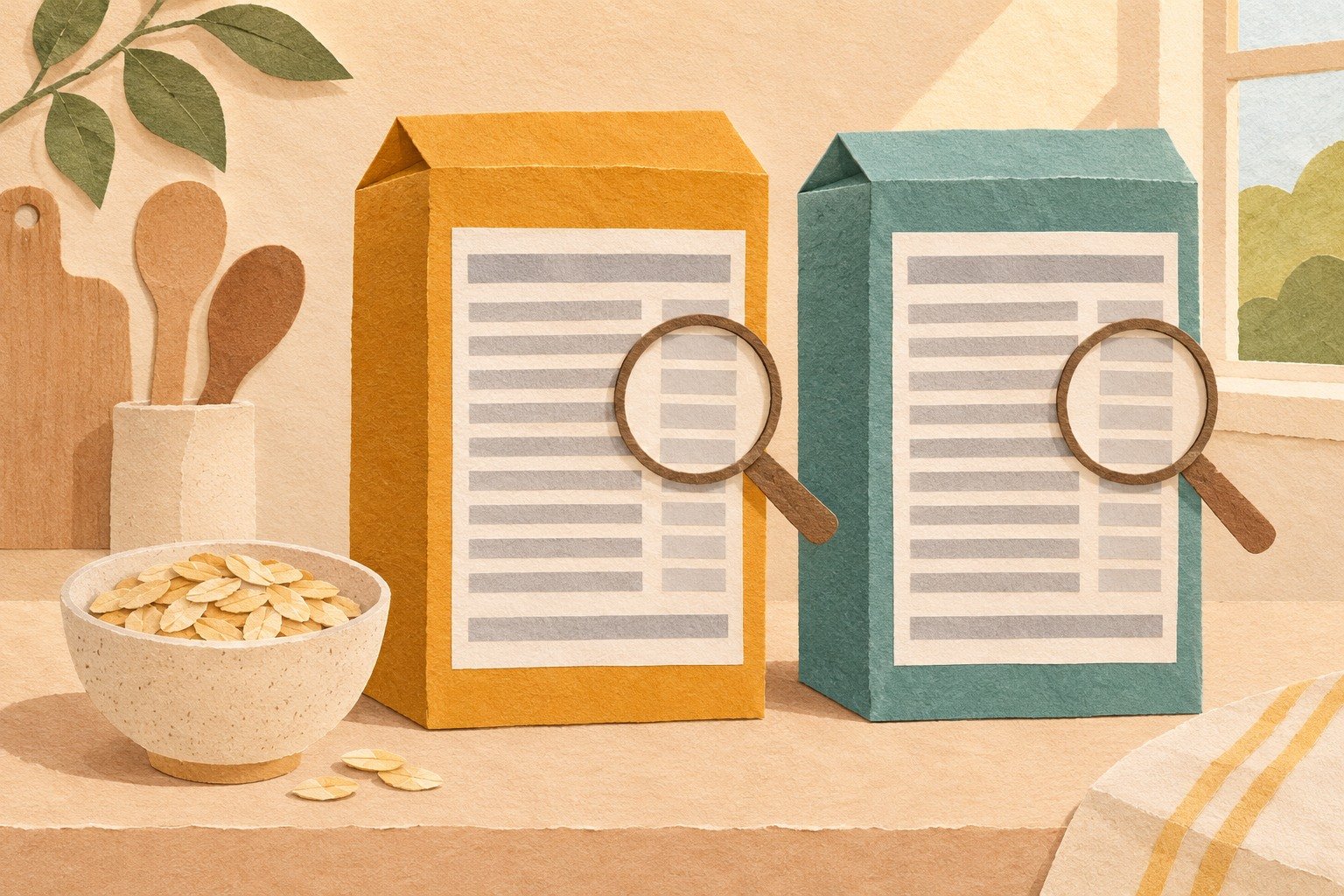
Two cereal boxes can look easy to compare until you notice that one calls 30 grams a serving and the other uses 50 grams. The smaller number on the front may simply describe a smaller amount of food. A useful label-reading habit starts by putting both products on the same basis.
You do not need a calculator for every shopping trip. Compare similar foods, use the same column, then return to the amount you are likely to eat. This guide shows the difference with a deliberately made-up example.
Start with two foods that do the same job
Choose a useful pair: two breakfast cereals, two plain yoghurts or two loaves of bread. Comparing cereal with yoghurt is a different question because the foods play different roles in a meal.
The Australian Government’s Health Star Rating guidance makes this same distinction: use the stars to compare similar products, rather than unrelated foods. Treat a front-of-pack rating as a comparison aid, then read the information relevant to your choice.
For example, if you need bread for tomorrow’s lunch, narrow the decision to two breads your household will eat and that fit your budget. You can make a useful comparison without examining every loaf on the shelf.
Find the per-100-gram column
Food Standards Australia New Zealand explains that nutrition information panels show average quantities per serving and per 100 grams, or per 100 millilitres for liquids. The food business determines the serving size, which can differ between products. The per-100-gram or per-100-millilitre column helps you compare similar products on an equal basis.
Follow one row across both panels. Check that you are looking at the same nutrient, the same column and the same units. Sodium, for instance, is commonly shown in milligrams; do not accidentally compare it with a number for a different nutrient.
A worked example: when the smaller number misleads
These are invented cereal labels for practising the calculation, not measurements of real products or recommended targets.
- Cereal A: serving size 30 g; sodium 120 mg per serving; sodium 400 mg per 100 g.
- Cereal B: serving size 50 g; sodium 150 mg per serving; sodium 300 mg per 100 g.
If you look only at the serving column, A seems lower: 120 is less than 150. But the servings are different sizes. For an equal 100 grams, B has less sodium: 300 rather than 400 milligrams.
Now imagine an equal 40-gram bowl of each cereal. Multiply each per-100-gram figure by 0.4. A supplies 160 mg of sodium; B supplies 120 mg. The comparison has changed because you have held the amount of food steady.
This example tells you which fictional cereal has less sodium for the same weight. It does not tell you everything about either food, or establish which breakfast you should eat.
Choose a question before scanning every number
The Australian Government’s Eat for Health label guide recommends comparing similar foods and checking nutrition claims against the panel. It points readers towards less saturated fat, salt and added sugars, and more fibre within an overall eating pattern.
Turn that into one manageable shopping question: “Which of these two breads has less sodium for the same weight?” After answering it, check any other feature that matters to you. A comparison is a way to gather information, rather than a contest with one number deciding everything.
Read the ingredient list for context
FSANZ says ingredients are listed in descending order of their weight when added. This helps you understand what the food is made from. It does not make the number of ingredients a health score.
Also, do not automatically read the panel’s “sugars” figure as “added sugar”. The Australian food-regulation policy paper on sugar labelling explains that the panel reports total sugars. The ingredient list provides additional context about sugar-based ingredients.
Keep allergy information, storage instructions and any dietary requirements in view too. A favourable number on one row does not override whether the food is suitable for you.
Finish with the portion and the meal
Use the per-serving column to understand the amount stated on that particular pack, remembering that your own portion may differ. Then put the food back into the meal you are planning. Our flexible dinner-planning guide can help with that broader decision.
For the next shop, keep the routine small: choose two similar foods, compare the same row per 100 g or 100 mL, and check the portion and ingredient information before deciding. A fair comparison is more useful than the smallest number you can find.