A home workout can start abruptly: you close the laptop, clear a patch of floor and go straight into the hardest movement. A warm-up gives that change of pace a little space. It can be simple, use no special equipment and connect directly to the activity you are about to do.
The useful pattern is to begin gently, add comfortable movement, then practise an easier version of the workout. Here is how to turn that pattern into a repeatable start, without treating a timer as permission to push through discomfort.
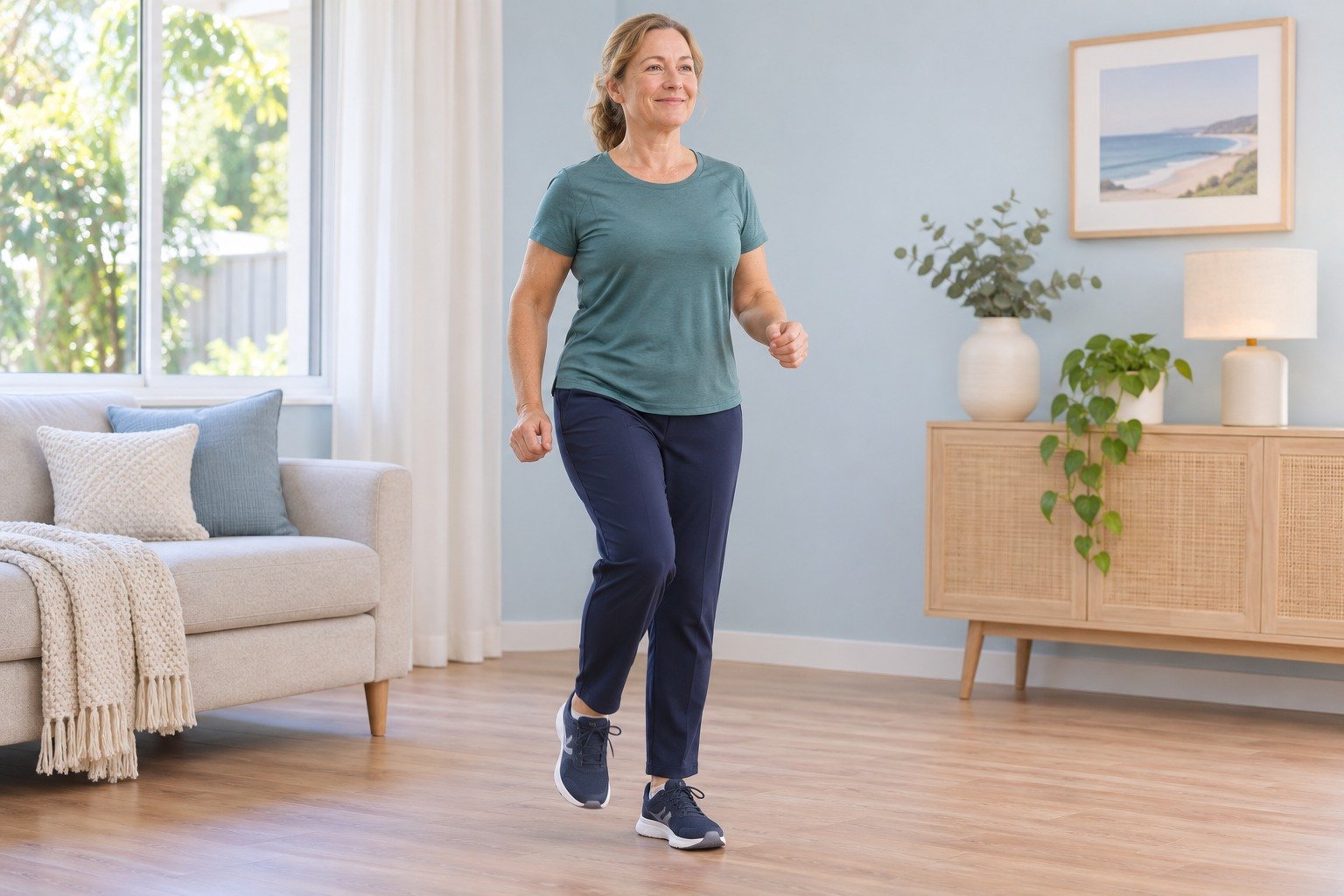
Start with a gradual change of pace
The American Heart Association recommends a warm-up of five to ten minutes before aerobic exercise, with a longer warm-up for more intense activity. Its practical suggestion is to do your planned activity at a slower pace. The aim is a gradual rise in breathing and heart rate.
For a walk, that could mean beginning with an easy stretch of your route before moving faster. For a home session, easy walking around a clear room can be the opening. Start at a pace you can control rather than trying to get breathless immediately.
Set up before you start: move the loose rug, give yourself room to step and put anything you need within reach. This is also a useful moment to decide what comes next. “Easy walking, a few gentle movements, then my first exercise” is enough of a plan.
Add comfortable movements
The NHS warm-up guide includes marching, heel digs, knee lifts, shoulder rolls and shallow knee bends. Its complete routine takes at least six minutes. You do not need to invent an elaborate sequence to make a start.
If these movements are suitable for you, use the illustrated NHS instructions to learn them. Keep the movement manageable: a heel placed gently forward is different from a forceful kick, and a shallow knee bend is different from dropping into a deep squat. Choose a comfortable range rather than trying to match someone else’s height or depth.
You could keep a short reminder beside your exercise space: “Walk first; move gently; rehearse.” The reminder is a cue to begin, not a scorecard. You do not have to make each day’s opening identical.
Rehearse what you are about to do
Victoria’s Better Health Channel advises warming up the muscle groups you will use, including dynamic flexibility exercises. That makes the next activity a useful guide to your preparation.
Before a familiar home strength session, an illustrative approach is to follow easy movement with a few controlled repetitions of the first exercise using an easier version or less resistance. This is a planning example, not a prescribed programme or a test of how much weight you can lift. Follow the technique and preparation advice supplied for your particular exercises.
If your session is based on our guide to starting strength training at home, read the exercise instructions before beginning. Keep the warm-up and the main session distinct in your plan, so the opening does not accidentally become your hardest effort.
Use a check-in, not just a countdown
Near the end of the opening, ask: can I move comfortably, and do I understand the first exercise? If the answer is no, change the plan. A completed timer does not make an unsuitable movement suitable.
Healthdirect recommends starting slowly and building up. It also advises seeking guidance from a doctor or exercise professional before a new exercise programme. If an exercise hurts, stop and seek advice rather than working through it. Existing injuries or health conditions are reasons to get help choosing appropriate activity.
Stop exercising and seek medical help for symptoms such as chest pain, extreme breathlessness or a very rapid or irregular heartbeat, as described in Better Health Channel’s exercise safety guidance. A warm-up cannot guarantee freedom from injury.
Leave time to slow down afterwards
The same gradual approach has a place at the other end of the session. The American Heart Association advises reducing walking speed for five to ten minutes when cooling down. Include the finish when you plan your available time, rather than ending the hardest effort and immediately sitting back at your desk.
Write the opening into the session
For your next workout, write one extra line above the exercise list: “Start gently, then practise.” Leave room in the session for that opening. If walking is your activity, our short-walk planning guide can help you choose a practical time and route. You can make the start familiar without making it complicated.